
Mahama describes Ghana–UAE partnership as blueprint for future global alliances
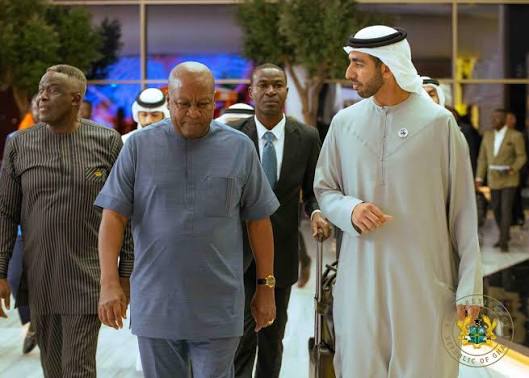
President John Dramani Mahama has described Ghana’s partnership with the United Arab Emirates (UAE) as a blueprint for the future of global alliances, arguing that modern partnerships must be practical, results-driven and mutually beneficial.
He revealed that Ghana’s newly established Goldbod initiative has generated more than US$10 billion in under a year, presenting it as proof that well-designed international cooperation can deliver tangible economic returns.
Speaking at the World Governments Summit 2026 in Dubai, President Mahama said the evolving Ghana–UAE relationship, alongside broader Africa–Gulf partnerships, is rapidly emerging as a critical pillar of the new global order — one anchored in shared responsibility, economic transformation and climate action.
He noted that traditional alliances, historically shaped by geopolitical rivalries and military blocs, must be reimagined to address borderless challenges such as climate change, food and energy insecurity, fragile supply chains and growing global inequality.
“The alliances of the future must be rooted in shared responsibility and based on our common destiny,” President Mahama told the summit.
He explained that Ghana’s decision to establish the Goldbod reflects a strategic shift toward greater sovereignty and value addition in the management of Africa’s natural resources. The initiative, which has already generated over US$10 billion, forms part of a broader effort to ensure the continent captures more value from its minerals and agricultural commodities instead of exporting them in raw form.
President Mahama outlined Ghana’s medium- to long-term ambition to process and add value to resources such as gold, manganese, bauxite, lithium and petroleum, as well as key agricultural products including cocoa, oil palm, cashew, cassava and soya.
According to him, Africa’s new alliances must move beyond extractive trade models and instead support industrialisation, supply-chain development and shared prosperity.
“Africa welcomes global partners not merely to trade with, but to transform with,” he said.
Climate Action and Ghana–UAE Cooperation
President Mahama identified climate action as a defining pillar of modern global partnerships, noting that although Africa contributes the least to global emissions, it suffers a disproportionate share of climate impacts.
He cited the Ghana–UAE partnership as a practical example, highlighting a US$30 million grant mobilised to support climate action, biodiversity conservation and inclusive development.
He stressed that climate action must be matched by climate justice, urging developed economies to honour commitments on climate finance, adaptation support and fair energy transitions.
Africa’s Place in the New Global Order
The President emphasised that Africa’s growing population, vast natural resources and expanding market of more than 1.3 billion people position the continent as central — not peripheral — to the future global economy.
He said initiatives such as the Accra Reset offer a roadmap for Africa’s transition from aid dependence to trade- and investment-led growth, while underscoring the importance of accountable governance, strong institutions and transparent leadership within African states.
President Mahama also reaffirmed Ghana’s commitment to peace and regional stability, particularly in West Africa, describing security as an essential foundation for development and sustainable partnerships.
He concluded by calling for renewed multilateralism, fairer global governance structures and alliances built on cooperation rather than confrontation.
“The future of global alliances is not about treaties alone,” he said. “It is about the kind of world we choose to build — where nations rise together, not apart.”
Source: Sekunde FMPresident John Dramani Mahama
About the Author